
EU AI Act

Only one detail added with AI? That's already enough to trigger labeling.

Since August 2, 2026, the EU AI Act's labeling requirement applies to AI-generated and AI-manipulated content placed on the EU market — and it affects the packaging industry 100 %. It's not just fully AI-generated packshots that fall under it, but the smallest generative retouch on an otherwise conventionally photographed image, too. Here's what the EU AI Act actually requires, who it applies to, and how brands can stay on the safe side.


WHAT IS THE EU AI ACT?

Transparency instead of deception


The EU AI Act is the world's first comprehensive regulation on artificial intelligence. One of its central pillars: Article 50 requires AI-generated or AI-manipulated image, audio, and video content to be clearly identifiable. The goal is simple – people should be able to tell when they're looking at a genuine photo and when they're looking at an AI-produced result.

Two key dates to know:

  • August 2, 2026: The disclosure obligation for AI-generated or AI-manipulated image, audio, and video content is legally binding from this date onward – a human-perceptible label is mandatory as of now.
  • December 2, 2026: In addition, AI system providers must make the labeling machine-readable – via metadata or watermarks, not just visible to the human eye. This deadline was pushed back by four months as part of the political agreement reached in May 2026; the labeling obligation itself as of August 2 remains unchanged.

Primarily responsible is whoever places a product carrying the content on the market, or publishes it, within the EU – in other words, the brand itself.


DOES THIS APPLY WORLDWIDE?

No – but the fine framework does


An important clarification we hear a lot in client conversations: the EU AI Act does not apply globally. It follows the so-called market-place principle: what matters is whether content is published in the EU, made accessible there, or whether a product advertised with it is placed on the EU market – regardless of where the content was produced.

For our global network, this means in practice: the labeling requirement only applies to jobs whose output is intended for the EU market. If a site outside the EU produces exclusively for a market outside the EU, Article 50 doesn't apply.

Don't confuse this with the basis used to calculate fines: if a violation of the EU labeling requirement is established, the fine is calculated based on the company's worldwide group annual turnover – not just its EU turnover. This mirrors a mechanism already familiar from the GDPR: the scope of the obligation is the EU, but the size of the sanction is based on global revenue.


Is Packaging & Premedia affected by the AI Act?

Yes, 100 per cent


The decisive phrase in the legal text comes down to a single word: "objects." A product is an object. Any image content that resembles a real product and could pass as genuine meets the EU AI Act's definition – regardless of any intent to deceive. What's assessed is purely the resemblance to reality. 

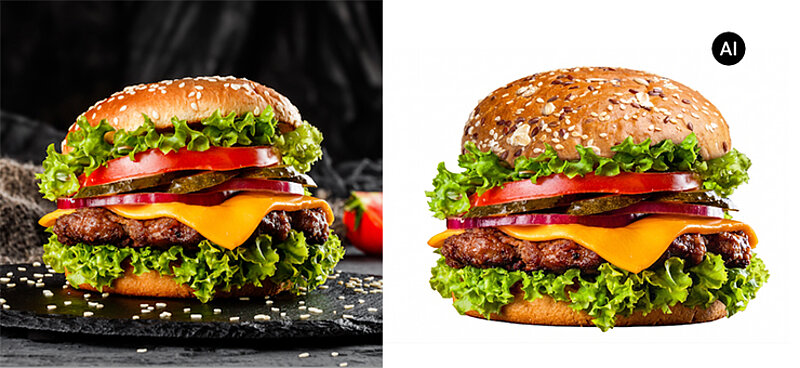
Importantly, this is not just about fully AI-generated images. Even when a photo was largely produced the conventional way – shot by a photographer – and only a single detail was added, altered, or removed using AI, the labeling requirement applies to that image. 
 

A practical example: you photograph a burger conventionally in the studio – the bun is smooth in the original shot. You then use generative AI retouching to add a seeded crust that was never on the actual product photographed. The photo as a whole remains "real" – but the added image content makes it a labeling-relevant piece of content under Article 50. The same applies the moment you use AI-powered Photoshop tools such as generative fill or AI filters to add, remove, or replace image content that wasn't there in the original.

For the FMCG and packaging industry, that means: the very tools that have accelerated our everyday work in recent years – from fully generated packshots to a single, localized AI retouch on a conventionally shot photo – are now at the center of the transparency obligation. Any brand producing or post-processing image content with AI assistance may be producing content subject to the labeling requirement. No matter how small the generative intervention was.

A special case remains the concept packshot for a product that doesn't exist on the market yet: legally unresolved so far – and therefore a case that should be actively agreed upon with your production partner rather than decided unilaterally.


HOW TO LABEL CORRECTLY?

Visible, unambiguous, in the right place


The legislator doesn't prescribe a specific wording or a mandatory icon. A note such as "AI-generated" or "AI Generated" is sufficient – what matters is the placement.

Sufficient is a label placed directly within the content itself, typically as a tag in the upper right corner of the image. The same applies to video; for audio, an audible notice is required.

Too weak, on the other hand, is anything detached from the actual content: only in the caption, only in the metadata, behind a "more info" link, or hidden in the legal notice. As soon as an image is shared, that connection is lost – and with it, the legal protection.

Important to know: the obligation is not retroactive. Content published before August 2, 2026 doesn't need to be labeled after the fact – but it does if it is republished.


WHAT HAPPENS IF YOU DON'T LABEL?

Up to €15 million


Ignoring the labeling requirement carries serious consequences: fines of up to €15 million or 3 % of worldwide group turnover – whichever amount is higher. On top of that come competition-law warnings and, in the worst case, blocked social media accounts. Anyone can file a complaint with the responsible supervisory authority, regardless of company size. The only exemption is purely private use.

In short: the EU AI Act is no longer a regulatory footnote — it's a hard business factor, wherever brands work with images.
 

Article: August 2026 by Kamill Wallach & Nina Lampert
Please note: This article is a technical analysis by Linked and does not constitute legal advice.


Why Linked?

We've prepared our internal processes and reporting – where we used AI, we tell you. And where we report nothing, no AI was involved.

The labeling decision itself is yours as the brand, since you're the one placing the product on the market. Our job is to give you a complete and consistent account you can rely on – on every order destined for the EU market, at every one of our ten global locations, following the same rules. That way, you keep control over your brand identity, even in an increasingly complex regulatory world.

Want to know where AI was involved in your current packaging data, or how our reporting process works in detail? Reach out to us.


Your direct contact person


I am always happy to hear from our customers and visitors! Please use the form below to get in touch with me.

Contact Form

Yes, I have read the privacy policy and agree that the data I have provided will be collected and stored electronically. My data will only be used strictly for the purpose of processing and answering my request. By submitting the contact form, I agree to the processing.